AnalysisE-bikes and micromobility
Choosing an e-bike or e-scooter in 2026: start with the legal limits where you live
The same e-bike can be a bicycle in California, a moped in Britain and an insured vehicle in the EU. Before comparing range or price, check the power, speed, insurance and riding rules that apply to you.
By Charjin Editorial Desk5 minutes11 sources

What should I check first when choosing an e-bike or e-scooter in 2026?
The short answer. Check whether the product fits your market's legal class: in the UK and EU that means a 250 W motor that stops assisting at 25 km/h for an e-bike, while US states commonly allow up to 750 W and 20 or 28 mph. Anything above those limits is usually a moped, which brings licensing, insurance and road-only riding.
Four checks before you pay.
- Match the motor's continuous rated power and assistance cut-off speed to your market's e-bike class.
- Treat a throttle as a legal question: it is allowed on US Class 2 bikes but needs type approval in Great Britain.
- For e-scooters, confirm that private riding is legal at all; in Great Britain it is not on public roads.
- Look for battery and electrical-system certification, such as UL 2849 or EN 15194 with EN 50604-1, regardless of market.
Why the legal class comes before the spec sheet
An e-bike that meets your local definition is, in law, close to a bicycle: no licence, no registration and access to cycle paths. One that exceeds it usually becomes a motor vehicle. In Great Britain that means a driving licence, a motorcycle helmet, registration, tax and insurance, and no riding on cycle tracks or cycle lanes.1
That makes the spec sheet a legal document. Two numbers matter most: the motor's continuous rated power and the speed at which assistance must stop. Both are set in law, and a bike built for one market may carry figures that are legal there and not at home.1,4
Great Britain: 250 W, 15.5 mph and no throttle without approval
In Great Britain, an electrically assisted pedal cycle (EAPC) must have a motor with a continuous rated power of no more than 250 W that stops propelling the bike above 15.5 mph. Riders must be at least 14. An EAPC needs no licence, registration, tax or insurance, and can be ridden on cycle paths but not pavements.1
A bike that can be propelled up to 15.5 mph without pedalling, such as a twist-and-go model, must be type approved. Without approval it falls outside the EAPC rules. Look for the markings the rules require: the continuous rated power, the maker's name and either the battery voltage or the maximum assisted speed.1
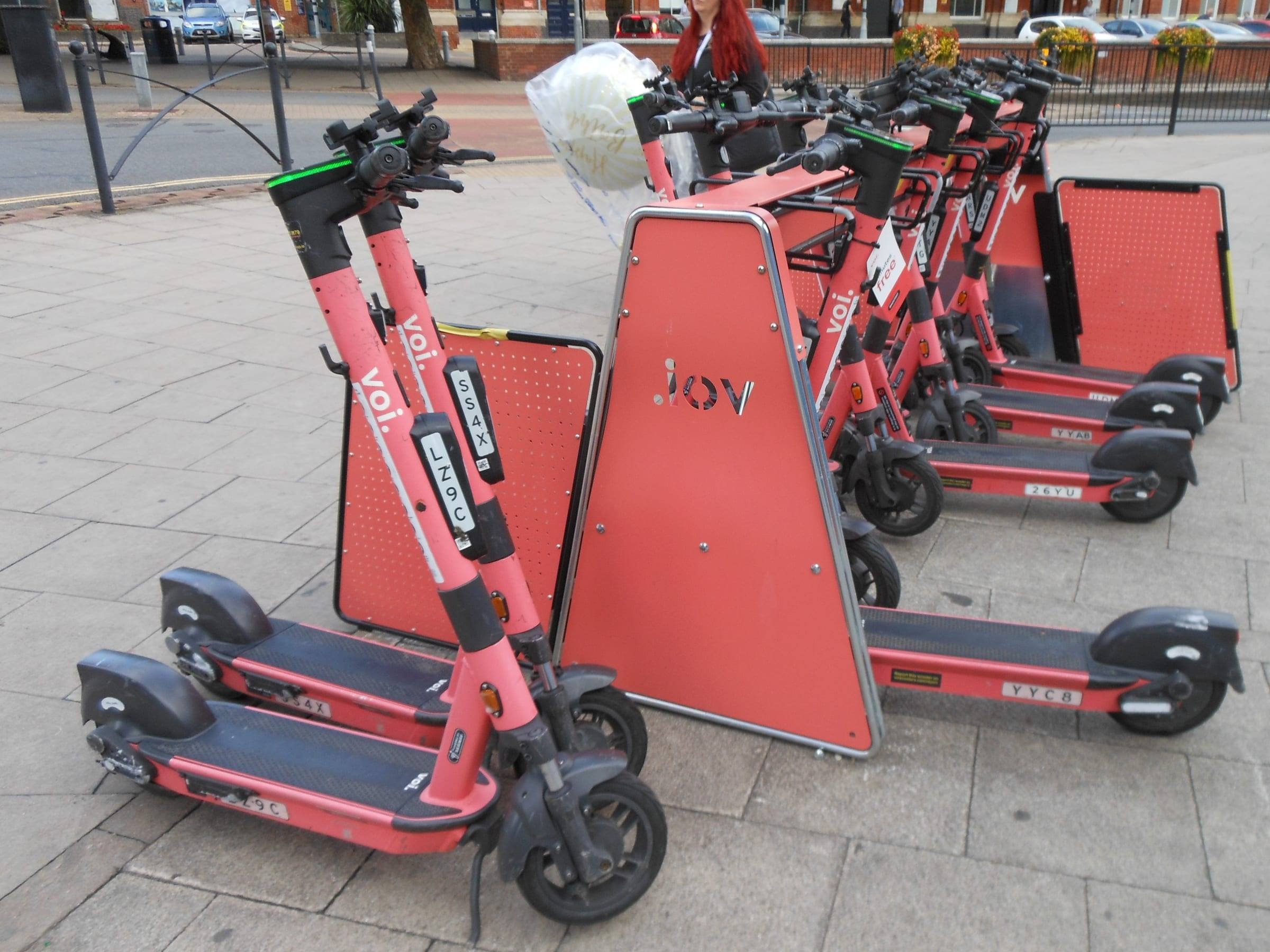
E-scooters are different. Riding a privately owned e-scooter on public roads, pavements or in parks is illegal, and police can fine riders, add penalty points or seize the scooter. Rental schemes in trial areas are legal. Riders need a full or provisional driving licence and the operator provides insurance.2
The rental trials apply in England only and are due to end in May 2028 after five extensions. Trial e-scooters are limited to 15.5 mph, a 500 W continuous motor and 55 kg. Buying a private e-scooter in Britain therefore means buying a vehicle that can only be used legally on private land, with the landowner's permission.3,2
European Union: the same e-bike limit, then a sharp step up
EU vehicle type-approval law does not apply to pedal cycles whose auxiliary motor is rated at 250 W or less and whose assistance cuts out when the rider stops pedalling and before 25 km/h. That matches the British limit, since 15.5 mph is about 25 km/h. Above it, a powered cycle with up to 1,000 W and a 25 km/h cut-off is an L1e-A vehicle, and a faster two-wheeler of up to 45 km/h and 4,000 W is an L1e-B moped.4
Insurance follows a similar line. The EU motor insurance rules, as amended in 2021, cover powered vehicles with a maximum design speed above 25 km/h, or weighing more than 25 kg with a design speed above 14 km/h. The directive names pedal-assisted e-bikes as the kind of small vehicle it does not aim to cover, but member states may add their own insurance rules.5
E-scooters show how far national rules then diverge. Germany limits e-scooters to a design speed of 20 km/h and a 500 W continuous motor, requires an insurance sticker, sets a minimum age of 14 and requires a type approval. Behavioural changes from a revised regulation take effect on 1 March 2027, with new technical rules for 2027 model-year vehicles.6
France allows e-scooters at up to 25 km/h for riders aged 14 or over. Civil liability insurance is required. Helmets are mandatory in Paris, in several departments and on 80 km/h roads outside towns. Riding outside permitted zones or carrying a passenger risks a €135 fine.7
United States: higher limits, set mostly by states
Federal consumer product law defines a low-speed electric bicycle as one with working pedals and a motor of less than 750 W, with a top motor-only speed below 20 mph for a 170 lb rider. That definition sets which product safety rules apply. Where and how the bike may be ridden is mostly a matter for each state.8
California is a useful example of the common three-class system. All three classes are limited to 750 W. Class 1 assists only while pedalling and stops at 20 mph. Class 2 may use a throttle but stops assisting at 20 mph. Class 3 assists only while pedalling, stops at 28 mph and must have a speedometer.9
Californian riders under 16 may not ride Class 3 bikes, and every Class 3 rider and passenger must wear a helmet. No insurance, licence or registration is needed for any class. Modifying a bike to change its speed class without relabelling it is prohibited, and selling devices that push it outside the e-bike definition is illegal.9
Since 1 January 2026, California has also defined pedal-less off-highway electric motorcycles, or e-motos. These are banned from public roads and must be registered as off-highway vehicles. A product sold as an e-bike without pedals may fall into that category.9
Charjin's comparison: the same bike in three markets
Converting the limits shows how far apart the markets are. A US Class 3 bike assists to 28 mph, about 45 km/h, with up to 750 W. In the EU that speed is moped territory under the L1e-B category. In Great Britain the same bike exceeds both the 250 W and 15.5 mph limits and would need moped-style licensing, registration and insurance.9,4,1
A US Class 2 bike with a throttle and a 750 W motor fails the British EAPC rules twice: on power and on unapproved throttle use. A British or EU-compliant bike, by contrast, sits comfortably inside the US Class 1 definition. Compliant European bikes travel well; American bikes often do not.9,1
Buyers importing a bike or ordering from an overseas website should check the continuous power rating and cut-off speed on the frame label before paying. A bike that is legal where it was made may not be legal where it will be ridden.1,9
Battery safety applies everywhere
Whatever the legal class, the lithium-ion battery is where the fire risk sits. Britain's product safety regulator points makers to BS EN 50604-1 for e-bike batteries and BS EN 15194 for e-bikes, and expects a battery management system that prevents thermal runaway. It records at least 10 deaths and almost 200 fires linked to e-bike and e-scooter batteries in the UK in 2023.10
In the US, the Consumer Product Safety Commission has proposed making UL 2849 mandatory for e-bikes and UL 2272 for e-scooters and similar devices, with extra tests. Its staff estimate that only about 11% of e-bikes currently comply with UL 2849. Until a final rule applies, asking for the certificate and the test lab's name is the buyer's job.11
Common questions
Can I ride my own e-scooter on the road in the UK?
Not in public. Riding a privately owned e-scooter on roads, pavements or in parks is illegal in Great Britain. Only rental e-scooters in official trial areas in England can be ridden on public roads, and the trials are due to end in May 2028.
Is a 750 W e-bike legal in the UK or EU?
Not as an ordinary e-bike. Both set a 250 W continuous power limit with assistance stopping at 25 km/h (15.5 mph). A more powerful bike is treated as a motor vehicle with licensing, registration and insurance requirements.
Do I need insurance for an e-bike?
Not for a standard e-bike in Great Britain, the EU's motor insurance rules or California. E-scooter riders in Germany and France do need insurance, and faster e-bikes classed as mopeds need it in Britain and the EU.
Can teenagers ride e-bikes?
In Great Britain the minimum age for an e-bike is 14. In California, riders under 16 may not use a Class 3 e-bike, and all Class 3 riders must wear a helmet.
Evidence register
The material behind the conclusion. Bracketed numbers in the text point here.
- 01
primary accessed 18 October 2026
Electric bikes: licensing, tax and insurance
GOV.UK. Great Britain EAPC power, speed, age, marking, approval and riding rules.
- 02
primary accessed 18 October 2026
Riding an electric scooter: the rules
GOV.UK. Illegality of private e-scooters in public and rental trial licence and insurance rules.
- 03
primary accessed 18 October 2026
Department for Transport, GOV.UK. Trial end date of May 2028, England-only scope and trial vehicle limits.
- 04
primary accessed 18 October 2026
EUR-Lex, European Union. Exclusion of 250 W, 25 km/h pedal-assisted cycles and L1e-A and L1e-B category limits.
- 05
primary accessed 18 October 2026
Directive (EU) 2021/2118 amending Directive 2009/103/EC on motor insurance
EUR-Lex, European Union. Speed and weight thresholds for compulsory motor insurance and exclusion of pedal-assisted e-bikes.
- 06
primary accessed 18 October 2026
Elektrokleinstfahrzeuge-Verordnung: FAQ
Federal Ministry of Transport (BMV), Germany. German e-scooter speed, power, age, insurance and approval rules and 2027 changes.
- 07
primary accessed 18 October 2026
Trottinette électrique : quelle est la réglementation ?
Service-Public.fr, French government. French e-scooter speed, age, insurance, helmet and fine rules, checked August 2026.
- 08
primary accessed 18 October 2026
15 U.S. Code § 2085 - Low-speed electric bicycles
Legal Information Institute, Cornell Law School. Federal definition of a low-speed electric bicycle: under 750 W and under 20 mph on motor power.
- 09
primary accessed 18 October 2026
Electric Bicycles and Other Devices (information bulletin, 27 May 2026)
California Highway Patrol. California e-bike classes, age and helmet rules, insurance and licence exemptions, tampering rules and e-moto definition.
- 10
primary accessed 18 October 2026
Statutory guidelines on lithium-ion battery safety for e-bikes
Office for Product Safety and Standards, GOV.UK. UK battery standards, battery management expectations and 2023 fire data.
- 11
primary accessed 18 October 2026
U.S. Consumer Product Safety Commission, Federal Register. Proposed mandatory UL standards and staff estimate of current e-bike compliance.
No corrections recorded. Last checked 18 October 2026.