AnalysisHybrids and plug-in hybrids
JAC's T9 plug-in hybrid pickup goes on sale in Malaysia from RM154,888. What a home charge costs against subsidised RON95
Malaysia's first plug-in hybrid pickup went on sale on 11 November. It is imported from China for now, and local assembly in Kedah is promised. Its 31.2 kWh battery is cheap to fill at home, but with petrol at the subsidised RM1.99 a litre, how much an owner saves depends on how much fuel the engine uses, and JAC has not published that figure.
By Charjin Editorial Desk4 minutes9 sources

Is the JAC T9 PHEV cheaper to run than a petrol or diesel pickup in Malaysia?
The short answer. On electricity alone it costs about RM15 per 100 km at TNB's off-peak home rate, using the 85 km WLTP range. For a Malaysian buying RON95 at the subsidised RM1.99 a litre, that only beats petrol if the engine would use more than about 7.7 litres per 100 km. JAC has not published a fuel consumption figure, so the real saving cannot yet be worked out.
What to know
- Two prices are quoted: RM154,888 (Pokde) and RM156,027.60 on the road before insurance (paultan.org) for the standard truck. The Adventure version costs RM8,000 more in both.
- Early cars are imported from China. Assembly at Feytech's plant in Kulim, Kedah, was planned to begin in November 2026, and no report so far confirms that it has started.
- The 31.2 kWh LFP battery is rated for 100 km on the older NEDC cycle, or about 85 km on WLTP. A full home charge costs about RM13 at the off-peak rate, before charging losses.
- ANCAP's five-star rating from 2024 covers the plug-in hybrid, after extra crash tests on the battery and high-voltage system.
What went on sale, and at what price
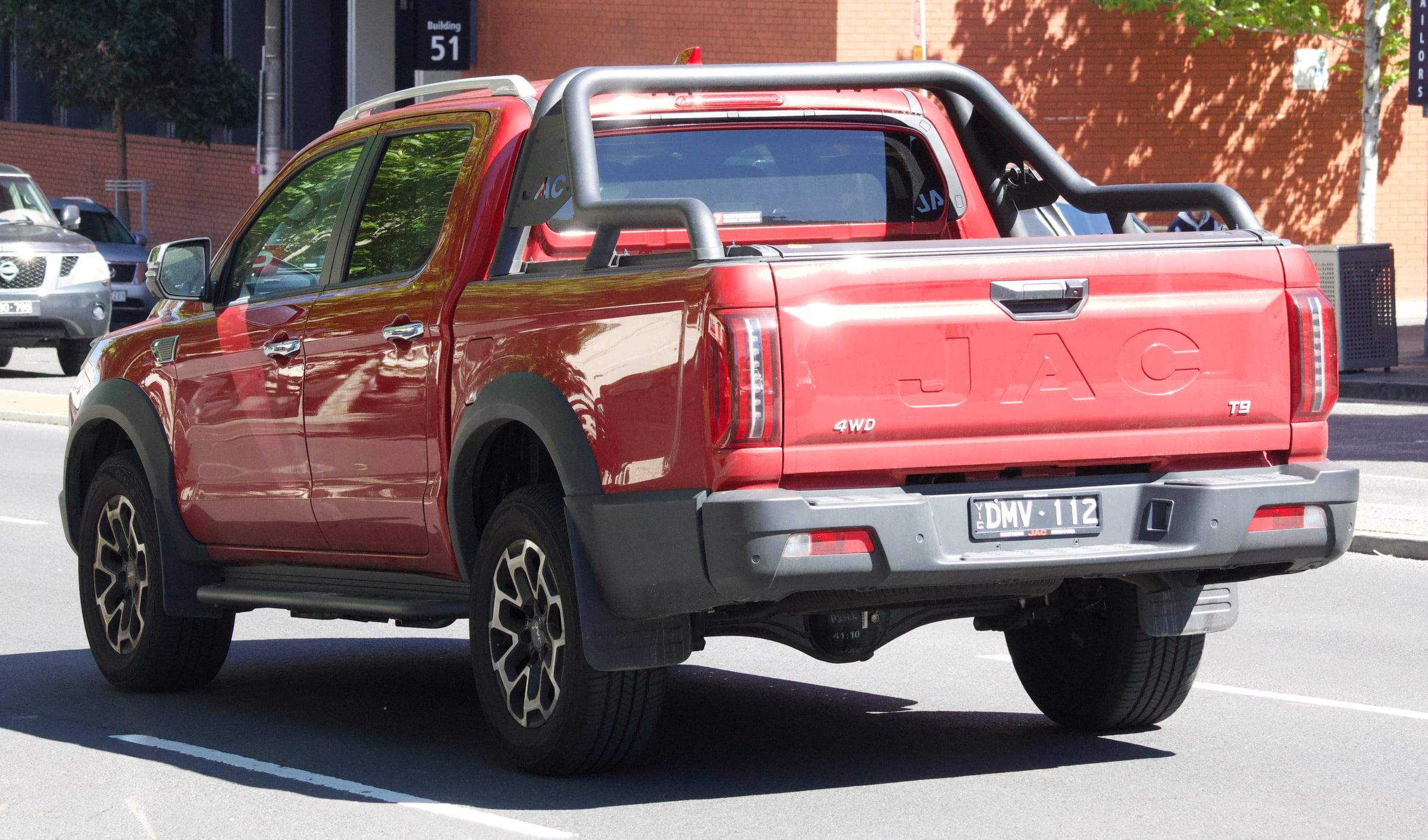
JAC's Malaysian distributor, Evolvelectric Motors, launched the T9 PHEV on 11 November. It is the only plug-in hybrid pickup on sale in the country. It comes in two versions. The Adventure adds all-terrain tyres and black alloy wheels and is otherwise the same as the standard truck.1,2
Launch reports quote two prices. Pokde gives RM154,888 for the standard truck and RM162,888 for the Adventure. paultan.org gives RM156,027.60 and RM164,027.60, on the road before insurance. Both versions differ by the same RM1,139.60, which suggests the gap covers on-the-road costs. Charjin could not confirm that from the distributor, which has not published a price list.1,2
The plug-in hybrid sits between the existing T9 models. The diesel costs about RM120,000 and the battery-electric T9 EV about RM200,000. So the hybrid costs about RM36,000 more than the diesel and about RM44,000 less than the EV.1
What the power and range figures measure
The truck pairs a 2.0-litre turbocharged petrol engine (211 PS, 370 Nm) with a four-speed hybrid transmission that has an electric motor built in, plus a second motor on the rear axle. Malaysian launch figures give 489 PS, or 360 kW, and 1,000 Nm from the whole system. Towing is rated at 3,500 kg braked, and the payload at 915 kg.1,2
The battery is a 31.2 kWh lithium iron phosphate (LFP) pack from Gotion High-Tech. The 100 km electric range and 1,000 km total range use NEDC, an older cycle that gives generous figures. On the stricter WLTP cycle the figures are about 85 km and 850 km. JAC has not said how much of the battery's capacity can be used.1,2
The launch reports quote 30 minutes for a DC charge from 15% to 80%. That step adds about 20 kWh, so it implies an average of roughly 40 kW, which is modest next to battery-electric cars. The truck can also power tools or appliances through a 15 kW vehicle-to-load supply, and there is a 220V socket for rear passengers. Every kilowatt-hour drawn this way reduces the electric range.1,2
Figures vary between markets. CarExpert reported the Australian version at 385 kW, with a 160 kW engine, compared with 360 kW in the Malaysian launch figures. Buyers comparing reviews from other countries should check which version is being tested.9,2
Worked example: a home charge against a tank of subsidised petrol
Since July 2025, TNB's domestic tariff has several parts. Households using up to 1,500 kWh a month pay 27.03 sen/kWh for energy, 4.55 sen for capacity and 12.85 sen for the network, which totals 44.43 sen/kWh. On the optional time-of-use tariff, the off-peak energy rate of 24.43 sen brings that total to 41.83 sen/kWh. Off-peak hours cover weekends, and weekdays before 2pm and after 10pm.6,7
Filling all 31.2 kWh therefore costs about RM13.05 off-peak, or RM13.86 on the standard tariff. Charging losses, the monthly fuel adjustment and taxes are not included. At the WLTP range of about 85 km, that comes to roughly 36.7 kWh per 100 km, or RM15.35 per 100 km off-peak.1,2,7
From 12 to 18 November, RON95 costs RM1.99 a litre under the BUDI95 subsidy for eligible Malaysians, capped at 200 litres a month. Without the subsidy it costs RM3.87. At RM15.35 per 100 km, electricity is cheaper than subsidised petrol only if the engine would use more than about 7.7 litres per 100 km. Against unsubsidised petrol, the break-even falls to about 4 litres.8
Plugging in still saves money for drivers who pay the unsubsidised price, and for any buyer whose petrol use goes over the monthly cap. For a subsidised driver, the saving depends on a fuel consumption figure JAC has not yet published. JAC also has not confirmed which petrol grade the engine needs. Charjin cannot work out a payback on the RM36,000 premium over the diesel until those figures appear.1,8
Local assembly is announced, not yet confirmed
On 30 September, Evolvelectric signed an agreement with FT Assembly, a wholly owned subsidiary of the Bursa-listed Feytech Holdings, to build T9 pickups in kit form at Feytech's 84,000 sq ft plant in Kulim, Kedah. The plug-in hybrid leads, followed by the diesel and the EV. The EV is targeted for January 2027.3,4
FT Assembly has put in RM3.6 million so far, and investment could reach RM8 million over three years. First-year capacity is about 3,000 trucks, with up to 30% local content as the target. Production was expected to start in November 2026. The launch-day report says the first trucks are fully imported, and Charjin found no confirmation that the Kulim line is running.1,3,4
Safety rating and warranty
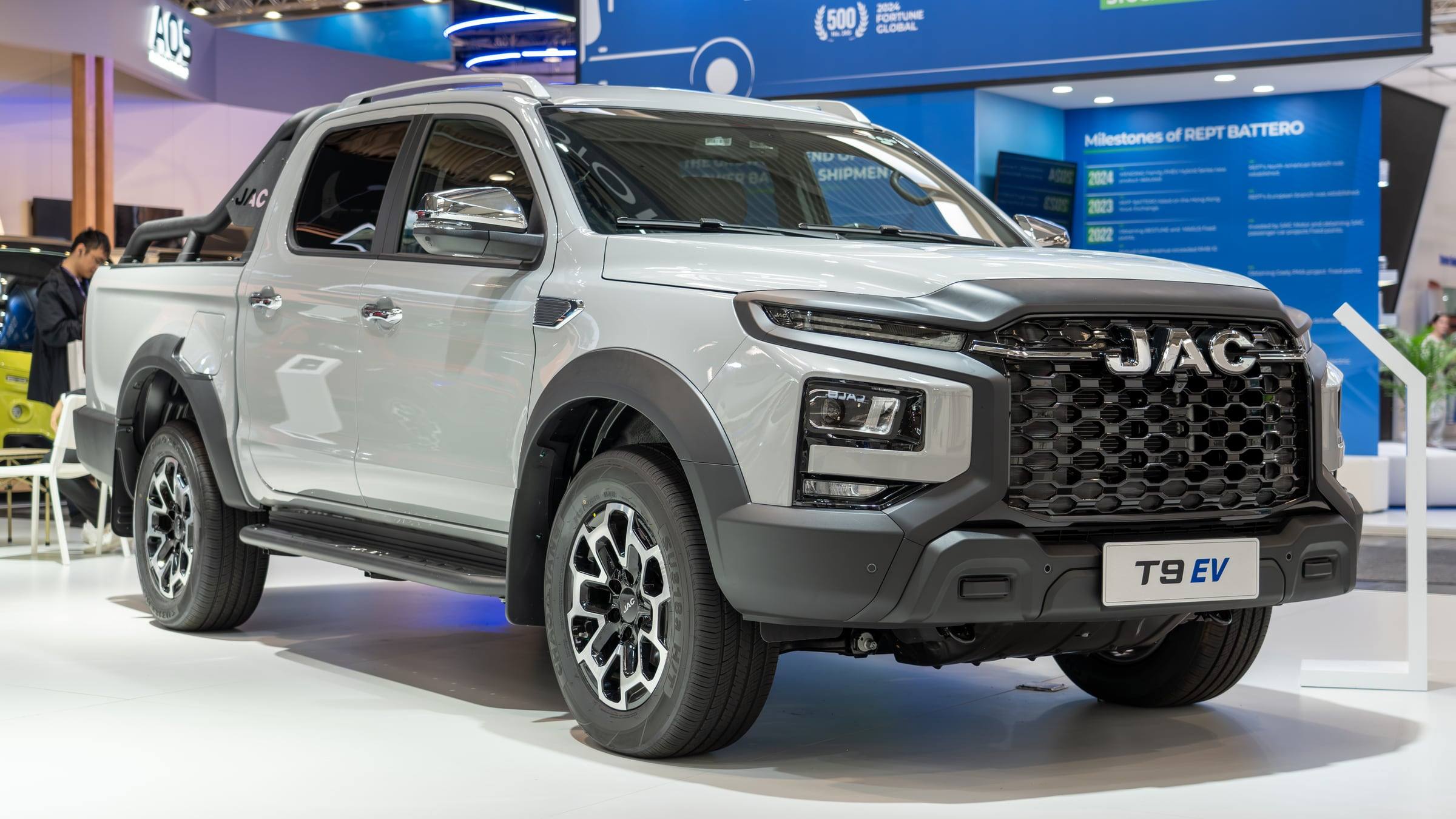
ANCAP tested the T9 in 2024 and awarded five stars. It scored 85% for adult occupants, 87% for children, 87% for vulnerable road users and 89% for safety assist. The rating covers the plug-in hybrid only because ANCAP ran an extra offset frontal test and an oblique pole test to check the battery and high-voltage system. It expires in December 2031.5
The Malaysian truck has seven airbags, including one between the front seats, and driver assistance that includes front and rear automatic braking and lane centring. The warranty runs for seven years on the vehicle and eight on the high-voltage battery, each capped at 150,000 km.1,2
What to check before you book
Ask the dealer for the full on-the-road price in writing, and whether it applies in East Malaysia. Ask whether your truck will be imported or assembled in Kulim, and whether the price or specification changes when local assembly starts.1,2,4
Ask for the official fuel consumption figure and the fuel grade, and for the DC charging power, which neither launch report gives. The quoted 30 minutes for a 15–80% DC charge and 3.5 to 5.5 hours on AC are claims. Charjin has not seen independent tests of either.1,2
Common questions
Is the JAC T9 PHEV made in Malaysia?
Not yet, as far as Charjin can confirm. Launch reports describe the first trucks as fully imported from China. Kit assembly at FT Assembly in Kulim, Kedah, was announced for November 2026, and there is no report so far that production has started.
How far can it go on electricity?
Up to 100 km on the NEDC cycle, or about 85 km on WLTP, from a 31.2 kWh LFP battery. Real range will be lower with a load, when towing, or with the air-conditioning working hard.
Does the ANCAP five-star rating apply to the hybrid?
Yes. ANCAP says its 2024 rating covers the plug-in hybrid and 2.0-litre diesel versions of the T9. The hybrid's rating relies on extra crash tests that checked the battery and high-voltage system.
Evidence register
The material behind the conclusion. Bracketed numbers in the text point here.
- 01
reference accessed 11 November 2026
paultan.org. Launch-day report with on-the-road prices before insurance, the CBU status, powertrain, battery, range, charging, dimensions, towing, equipment and warranty, plus the diesel and EV prices.
- 02
reference accessed 11 November 2026
JAC T9 PHEV Petrol Debuts As Malaysia's First Locally Assembled Plug-In Hybrid Pickup
Pokde.Net. Launch report giving RM154,888 and RM162,888, the 360 kW and 1,000 Nm system output, motor outputs, NEDC and WLTP ranges, charging times and warranty.
- 03
reference accessed 11 November 2026
JAC to assemble T9 pickups locally
New Straits Times. Reports the Evolvelectric and FT Assembly agreement, the Kulim plant size, the RM3.6 million and RM8 million investment, 3,000-unit capacity, 30% local content target and the November 2026 and January 2027 timings.
- 04
reference accessed 11 November 2026
JAC to locally assemble T9 pickups in Kulim (Bernama TV news, 30 September 2026)
Bernama. National news agency report of the 30 September agreement, the phased order (PHEV first, then diesel and EV) and statements by Evolvelectric's and Feytech's chief executives.
- 05
primary accessed 11 November 2026
ANCAP. ANCAP rating page: five stars from 2024, the four assessment scores, coverage of PHEV and diesel variants, extra PHEV crash tests, and December 2031 expiry.
- 06
primary accessed 11 November 2026
Tenaga Nasional Berhad (myTNB). TNB's tariff page, which sets out the domestic general and time-of-use tariffs and the weekday and weekend off-peak hours.
- 07
data accessed 11 November 2026
TNB new electricity tariff calculation from July 2025
paultan.org. Breaks down the July 2025 domestic tariff: energy, capacity and network charges per kWh, the 1,500 kWh block, the retail charge and the time-of-use rates.
- 08
data accessed 11 November 2026
Malaysia fuel price this week: RON95, RON97 and diesel
paultan.org. Fuel prices for 12–18 November 2026: BUDI95 RON95 at RM1.99 with a 200-litre monthly cap, unsubsidised RON95 at RM3.87, RON97 and diesel.
- 09
reference accessed 11 November 2026
2026 JAC T9 PHEV Australian edition dual-cab ute unveiled
CarExpert. Gives the Australian specification of 385 kW and 1,000 Nm with a 160 kW engine, 130 kW front and 150 kW rear motors, and a 31.2 kWh LFP battery.
No corrections recorded. Last checked 11 November 2026.